
Water-wise landscaping in the Texas Hill Country starts with understanding your property’s natural conditions, from sunlight and soil to rainfall and drainage.
The Texas Hill Country is a beautiful place to live outdoors, but it asks homeowners to think carefully about the land. Long stretches of heat, occasional dry spells, changing rainfall, and deer activity can affect how a landscape looks and performs. Some properties also have rocky ground, steep grades, or limited natural shade.
Water-wise landscaping is not a single look or a rule that every yard must follow. It is a planning approach: make good decisions about where plants belong, how outdoor spaces are used, and how water reaches the landscape. Whether you are designing a new property or updating a mature yard, the steps below can help you create a setting that feels both refined and appropriate for the Hill Country.
In This Guide
- 1. Read the Property Before Choosing Plants
- 2. Choose Plants for Their Location and Water Needs
- 3. Keep Lawn Where It Has a Purpose
- 4. Think About Soil, Mulch, and Rainfall
- 5. Design Irrigation Around the Planting Plan
- 6. Account for Deer and Long-Term Care
- 7. Bring Everything Together in One Coordinated Design
- A Water-Wise Landscape Can Still Feel Luxurious
- Frequently Asked Questions
Quick Answer
To plan a water-wise landscape in the Texas Hill Country, start with your property’s sun, shade, slopes, and drainage. Choose plants suited to those conditions, group areas with similar water needs, and keep lawn where it has a purpose. Plan irrigation alongside planting and hardscaping, and allow for establishment watering. A water-wise yard can still feel green, layered, and inviting.
1. Read the Property Before Choosing Plants
Walk the property at different times of day. Where does the afternoon sun linger? Which areas receive morning light or relief from mature trees? After rainfall, notice whether water soaks in, flows downhill, or collects beside paths and planting beds. These observations can influence plant placement, materials, and the overall layout.
Think about the view from the house and the routes people already take through the yard. A sunny front approach may need a different design from a shaded patio near the back door. Likewise, a rocky slope deserves more consideration than a flat, sheltered planting area. The best plan responds to the actual site instead of forcing the same design onto every property.
Acacia’s landscape design process begins with measurements and existing-site features so the proposed work can be developed as one coordinated plan rather than a collection of unrelated improvements.
2. Choose Plants for Their Location and Water Needs
A useful starting point is the principle of placing the right plant in the right location. Consider sun exposure, mature size, drainage, soil conditions, and how much maintenance the homeowner wants to take on. Native and well-adapted plants can offer attractive options, but neither label guarantees that a plant will thrive in every spot.
Group plants with similar watering needs together. Sometimes called hydrozoning, this makes it easier to plan watering for a bed without giving nearby plants more or less water than they need. Layered planting can still provide color, texture, privacy, and seasonal interest; a water-wise garden does not have to look sparse.
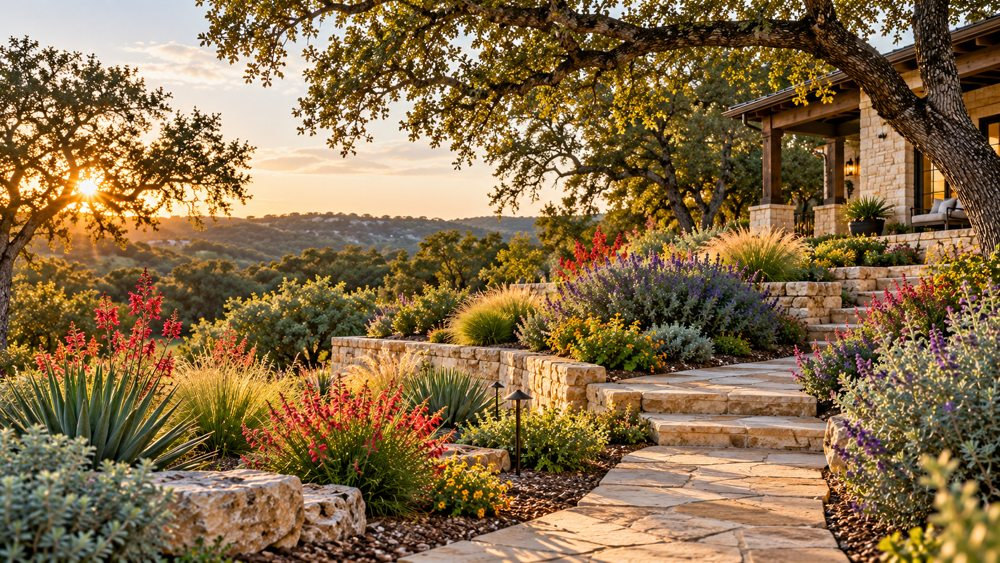
Layered planting can bring color, texture and a refined sense of place to a water-conscious landscape.
Before finalizing selections, consider how each plant will look at maturity. Allow enough room for growth, preserve important sightlines, and favor combinations that suit the home’s architecture and surrounding landscape.
3. Keep Lawn Where It Has a Purpose
A water-conscious landscape does not require removing all grass. A usable lawn can make sense for children, pets, open views, or outdoor activities. The key question is whether each grassy area serves a purpose or simply fills space by default.
In areas where turf adds less value, a considered mix of planting beds, stone paths, seating areas, and patios may be more practical. Hardscape and planted areas should feel connected in scale and material, so the property still reads as a garden—not a patchwork of unrelated surfaces.
Reviewing Acacia’s broader landscaping services early in the project can help align lawn, planting, hardscapes, shade features, and lighting around how the household actually uses its outdoor space.
4. Think About Soil, Mulch, and Rainfall
Water-wise planning is not only about how often a sprinkler runs. Soil depth, texture, slope, and drainage also influence how water moves through a property. Conditions can vary even within the same yard, especially where natural rock, fill, or older landscape work is present.
Mulch around suitable planting areas can help limit evaporation and moderate soil temperatures. The appropriate material and depth depend on the plants and site, and mulch should not be piled against tree trunks or plant stems. Soil preparation and drainage changes also need to be based on the property rather than a one-size-fits-all formula.
During a site walk, note where stormwater travels after a heavy rain. An attractive path or patio should not create new runoff problems for nearby beds, foundations, or neighboring areas.
For further guidance, see Texas A&M AgriLife Extension’s Xeriscape: Landscape Water Conservation resource, which discusses plant selection, soil preparation, mulching, and efficient irrigation.
5. Design Irrigation Around the Planting Plan
Even drought-tolerant plants often need supplemental water while their roots become established. For that reason, the irrigation approach should be considered while the planting plan is being developed—not added at the end when beds, walls, and walkways are already settled.
Lawns and planting beds can have different watering requirements. Appropriate zones, placement, and controls can help deliver water where it is needed. On its existing irrigation systems page, Acacia describes using drip irrigation in landscape beds and offering different approaches for grass depending on the application.
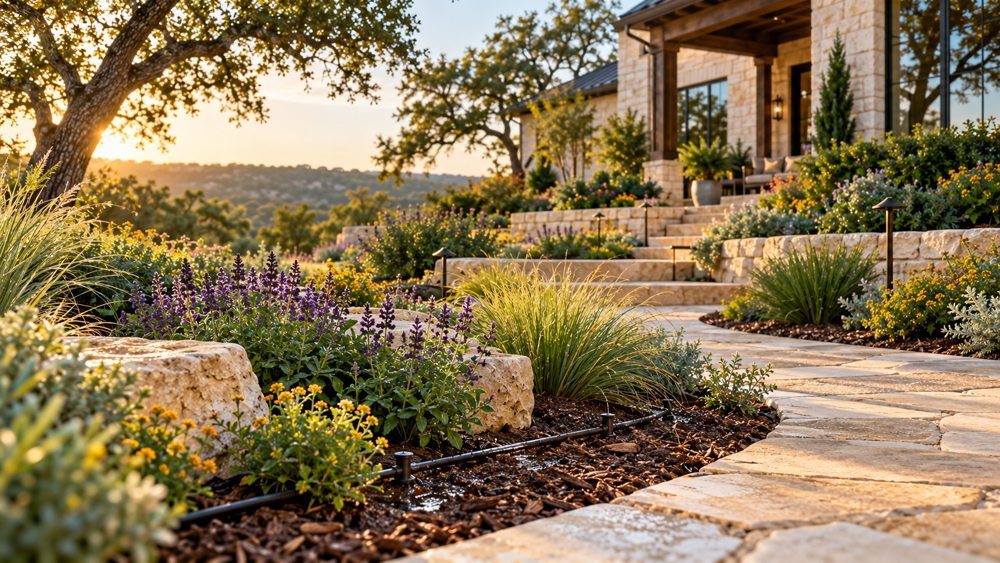
Targeted drip irrigation can support planting beds as part of a coordinated, water-wise landscape plan.
Watering needs change with weather, plant age, and seasonal conditions. Check current restrictions with the property’s local water provider before setting a schedule; rules can differ across Boerne, San Antonio, and other Hill Country communities. No irrigation design should be presented as a substitute for those requirements.
6. Account for Deer and Long-Term Care
Deer are a familiar presence on many Hill Country properties, and their browsing patterns can influence a planting plan. If the yard sees regular activity, raise that during design conversations rather than discovering the issue after installation.
Some plants are less appealing to deer than others, but no plant is reliably deer-proof in every situation. Young trees may need protection, and plant choices should reflect the property’s exposure and what has happened in the surrounding landscape.
Maintenance still matters in a water-wise yard. New plantings may need closer attention, mulch should be checked periodically, irrigation settings may need seasonal adjustment, and damaged or poorly performing plants should be evaluated before they are automatically replaced with the same variety.
7. Bring Everything Together in One Coordinated Design
A successful landscape feels deliberate because its pieces have been considered together. Planting, irrigation, lighting, outdoor living areas, views, paths, and maintenance expectations all affect one another. A coherent design helps homeowners see these relationships before installation begins.
Begin by identifying the essentials: perhaps a welcoming entry, shaded gathering area, softer planting near the home, or a more usable backyard. Acacia’s approach allows clients to review detailed plans, plant information, and material samples as the design is refined.
Once the direction is approved, landscape installation can be coordinated with the planting and supporting features included in the agreed project scope. This is more useful than treating each improvement as an isolated decision.
Water-Wise Landscaping in the Texas Hill Country Can Still Feel Luxurious
Luxury landscaping is not measured by how much lawn a property has or how many plants fill a bed. It often comes from balance: mature shade, a thoughtful palette of stone and greenery, inviting places to gather, and transitions that feel natural from the home to the land.
Water-wise choices can reinforce that sense of intention. Carefully grouped plants can frame a view, a shaded seating area can make an outdoor room more comfortable, and paths can invite movement through the landscape without requiring every space to be turf.
For ideas about how hardscape, planting, and outdoor living areas work together, browse Acacia’s Luxury Landscape Portfolio. Homeowners exploring local services can also learn more about landscaping in Boerne and other Hill Country communities.
A More Thoughtful Landscape Starts with the Site
Planning a new landscape or updating an existing Hill Country property? Acacia Landscape & Design can help you explore how planting, irrigation, hardscaping, and outdoor living fit together around your home and priorities.
Frequently Asked Questions
What is a water-wise landscape?
It is a landscape planned around site conditions and thoughtful water use. Suitable plants, purposeful lawn areas, soil and mulch considerations, and irrigation coordinated with the planting plan can all contribute.
Do I need to remove all my grass to conserve water?
No. Lawn can remain where it is useful for play, pets, or open space. The goal is to size it intentionally and use planting or outdoor-living features where they better serve the property.
Are native plants always drought-tolerant?
Not necessarily. Native plants differ in their moisture needs, and even locally appropriate species must be matched to a property’s sun, drainage, and soil conditions.
Will drought-tolerant plants need watering after installation?
Often, yes. New plants commonly need establishment watering. The amount and frequency depend on the plant, weather, soil, and applicable local watering rules.